Percent Error Calculator
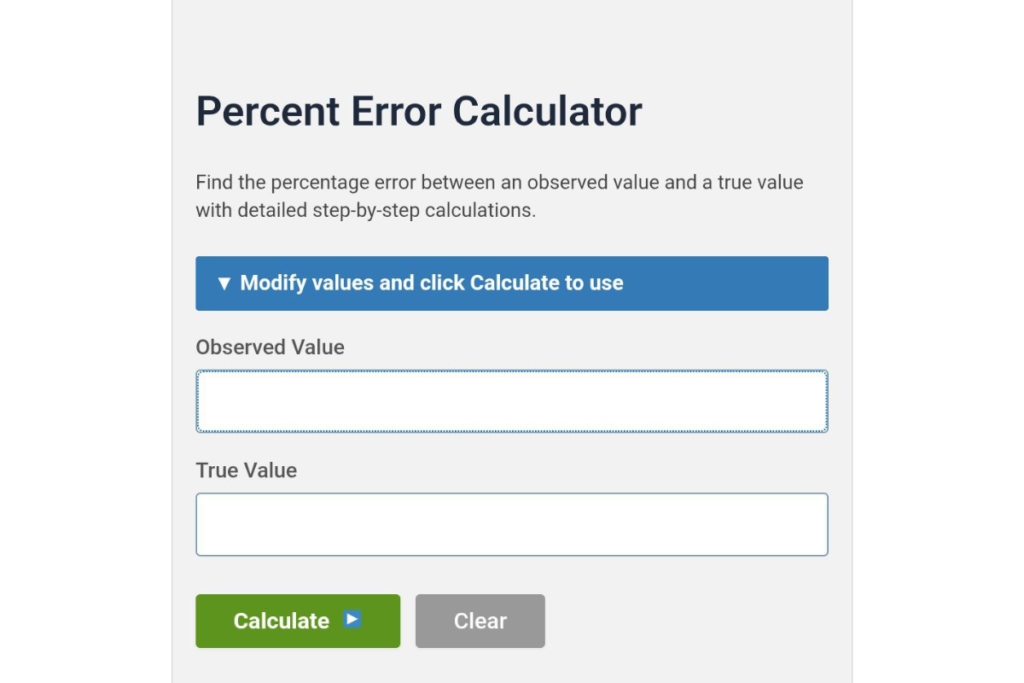
Find the percentage error between an observed value and a true value with detailed step-by-step calculations.
The Percent Error Calculator is a useful mathematical and scientific tool that allows you to easily determine the percentage difference between any observed value and its true value. The use of percentage error is of great importance in science, mathematics, engineering, and laboratory experiments.
When we conduct an experiment or take a measurement, the result obtained often differs slightly from the actual value. This discrepancy can arise from various causes, such as limitations in the measurement device, calculation errors, or human error. Percentage error is used to express this difference as a percentage.
With the help of an Online Percent Error Calculator, this calculation can be performed very quickly and easily. You simply need to enter the observed value and the true value, and the tool will instantly display the result.
What is Percentage Error?
Percentage Error is a metric that indicates the magnitude of the difference between an observed value and a true value. It is expressed as a percentage to make it easy to understand how accurate a particular measurement is.
When the measured value and the expected value in an experiment are nearly identical, the percentage error is low. However, if there is a significant discrepancy between the two values, the percentage error will be high.
For example:
Observed Value = 56.891
True Value = 62.327
Percentage Error =
|56.891 − 62.327| / 62.327 × 100 = 8.722%
This indicates that there is an error of approximately 8.7% in the measurement.
How is Percentage Error Calculated?
To determine the percentage error, one must first calculate the absolute error.
Absolute Error
Absolute Error = |Observed Value − True Value|
This represents the direct difference between the observed value and the true value.
Relative Error
Relative Error =
|Observed Value − True Value| / True Value
This compares the error against the true value.
Percentage Error Formula
Percentage Error =
|Observed Value − True Value| / True Value × 100%
This formula expresses the measurement error as a percentage.
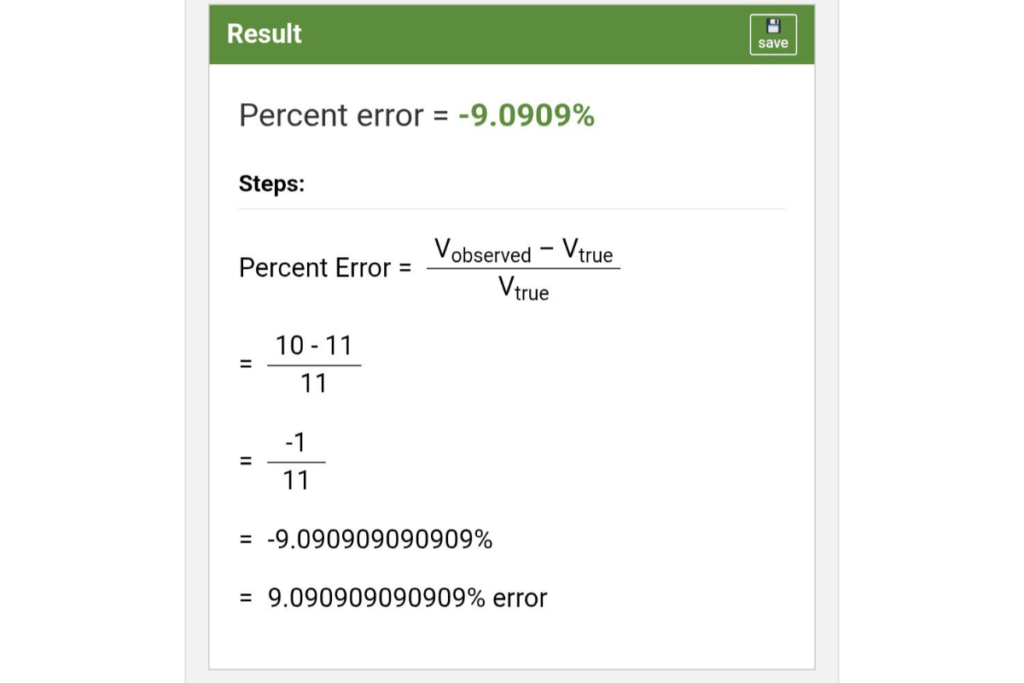
What is a Negative Percent Error Calculator?
Typically, the percentage error is always positive because the absolute value is used. However, if the absolute value is not used, the percentage error can also be negative.
Example:
Observed Value = 7
True Value = 9
Percentage Error =
(7 − 9) / 9 × 100 = −22.22%
A negative percentage error indicates that the observed value is lower than the true value.
If the observed value is higher than the true value, the percentage error will be positive.
The Significance of Percentage Error
Percentage error helps us understand how accurate a measurement is.
Small Percentage Error
If the percentage error is low, it implies that the result of the experiment is very close to the true value.
Large Percentage Error
If the percentage error is high, it suggests that there may be an error in the measurement, or the experimental method used is flawed.
How to Use the Percentage Error Calculator?
Using this tool is very simple.
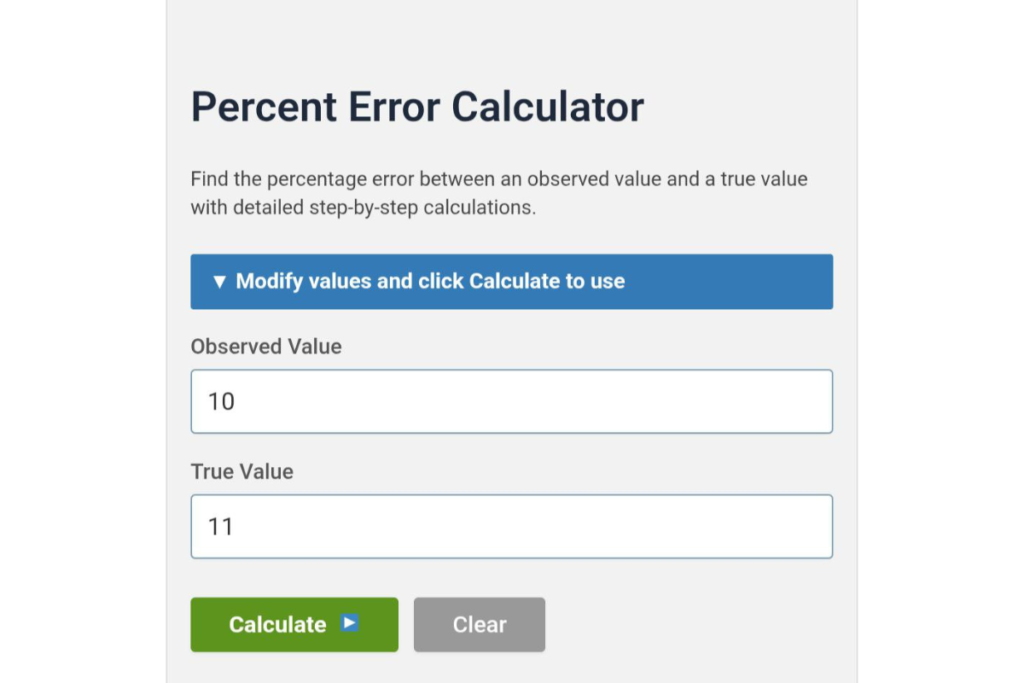
Step 1 Enter the Observed Value
First, enter the value obtained from your experiment.
Step 2 Enter the True Value
Now, enter the value that represents the actual or accepted value.
Step 3 Click on ‘Calculate’
The calculator will instantly compute the percentage error and display the result.
Benefits of the Percent Error Calculator
This tool offers several significant advantages:
Fast calculations
Accurate results
Easy-to-use interface
Useful for students and researchers
Mobile-friendly tool
Free online calculator
Conclusion
The Percent Error Calculator is a simple and effective online tool that helps you quickly and accurately calculate the percentage difference between an observed value and a true value.
Related Post :- Fraction Calculator Online – Solve Fraction Problems Instantly
This tool is particularly useful for students, teachers, scientists, and engineers, as it simplifies complex calculations. If you need to determine the accuracy of an experiment or measurement, this calculator is an excellent solution.