
Root Calculator
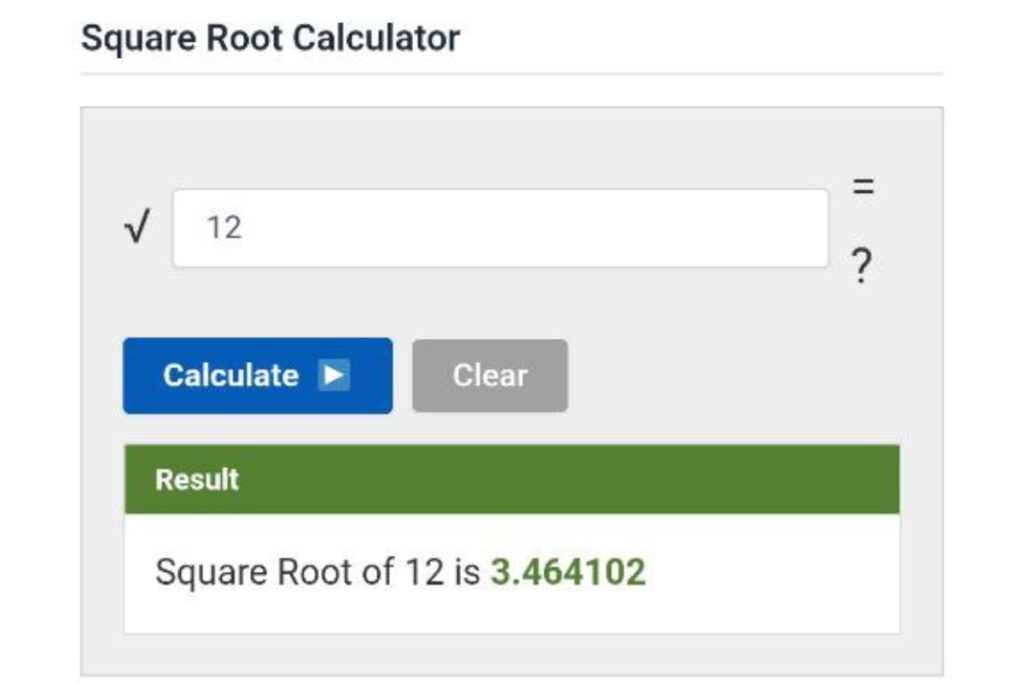
Square Root Calculator
Cube Root Calculator
General Root Calculator
The concept of “root” is considered extremely important in mathematics. Finding the square root or nth root of any number is the foundation of algebra and higher mathematics. If a number is 𝑎
a and its nth root is 𝑏
b, then this means that multiplying 𝑏
b by itself n times will equal 𝑎
a.
This is written as an equation:
n√a = b
bⁿ = a
Most people use calculators these days, but understanding the basic principle is just as important. Let’s understand it step by step.
Step 1: Understand and estimate the square root
When n = 2, it is called the square root.
For example:
√25 = 5
because 5 × 5 = 25
But not every number has a square root. For example, √27.
In such a situation, we have to use the method of estimation.
Procedure for finding the square root:
Choose an approximate number (b).
Divide the number by b and get a new number (c).
Average b and c.
Use the new average number again.
Repeat the process until the result stabilizes.
Example: Round √27 to three decimal places.
Let’s assume the initial estimate is 5.125.
27 ÷ 5.125 = 5.268
(5.125 + 5.268) / 2 = 5.197
Then:
27 ÷ 5.197 = 5.195
(5.195 + 5.197) / 2 = 5.196
Now the result is stable.
So, √27 ≈ 5.196
Step 2: Method for Finding the Nth Root
When the value of n is greater than 2, such as 3, 4, 5, or 8, the calculation becomes a little more complicated.
Example:
³√8 = 2
Because 2 × 2 × 2 = 8
But if we want to find the 8th root, the process is as follows:
Nth Root Calculation Steps:
Choose an approximate number (b).
Divide a by bⁿ⁻¹.
You get a new number (c).
Find the new average:
[b × (n−1) + c] / n
Repeat this process.
Example: ⁸√15 rounded to three decimal places.
Initial guess: 1.432
15 ÷ (1.432⁷) ≈ 1.405
Average:
(1.432 × 7 + 1.405) / 8 = 1.388
Then repeat:
15 ÷ (1.388⁷) ≈ 1.403
Further processing stabilizes the result at 1.403.
So, ⁸√15 ≈ 1.403
Step 3: Why is it better to use a calculator?
Although the method above is correct, repeatedly calculating powers and performing division by hand is quite time-consuming.
This is why root calculators are increasingly used today.
A digital calculator:
Gives accurate results instantly
Provides values correct to decimals
Useful even for large numbers
Saves time
Where is root calculation useful?
Root calculation is important in the following fields:
Engineering
Physics
Statistics
Data Science
Geometry
Competitive Exams
Many competitive exams ask for approximation-based calculations, so understanding this process is essential.
Conclusion
Square root and nth root are fundamental concepts in mathematics. Estimation and averaging can help us arrive at accurate results, but it’s time-consuming.
Related Post :- Free Exponent Calculator – 7 Easy Rules, Formulas & Examples
Digital tools simplify and speed up this process.
If you regularly have to perform complex calculations, using a calculator is a more effective solution.
Understanding math is important, but using the right tools is equally crucial.